
Key Takeaways
- SaaS customer support keeps business users productive and protects renewals.
- One helping hand isn’t enough to keep customers; confusion or slow support increases the likelihood of churn.
- Repeat tickets, declining usage, and silence at renewal are all indicators that give teams time to act.
- Useful metrics include response time, resolution time, satisfaction, effort, and revenue retention, and you should set targets for your own business.
Outsourcing is most effective when your outsourcing partner is willing to train their agents on your product, follow your escalation guidelines, and safeguard customer information.
According to SaaS Capital’s 2025 retention benchmarks, the median private B2B software company retains approximately 91% of its recurring revenue annually before upsells. The remaining 9% leaves through cancellations and downgrades. SaaS customer support interacts with customers weekly, so it influences many of those choices.
This guide outlines what B2B SaaS customer support entails, the metrics to track, the signs an account is about to churn, and when outsourcing support can benefit Canadian software companies.
What Is SaaS Customer Support?
The customer support offered by SaaS companies after their clients subscribe to the solution is referred to as SaaS customer support. It includes information about setup questions, account/billing requests, troubleshooting & help with features.
Customers pay monthly or yearly, so support covers the entire subscription period. Some buyers call this client support SaaS, meaning help for paying business clients.
Main Support Channels
- Email and web tickets for detailed and less urgent issues
- Quick questions in the app and live chat
- Call for pressing issues and complicated accounts
- Self-help articles for clients to read.
How a SaaS Customer Support Model Is Organized
Most teams are in tiers. Tier 1 handles common questions, Tier 2 handles more in-depth troubleshooting, and Tier 3 involves engineers who fix the product.
This customer support SaaS model ensures simple issues are handled quickly, and complex ones are routed to the right people. Businesses with multiple channels rely on omnichannel customer support to prevent clients from repeating themselves.
Why SaaS Customer Support Matters
Subscription software is now commonplace infrastructure in Canada. According to Statistics Canada, 48% of Canadian businesses adopted cloud computing in 2023, with the information and cultural industries reporting the highest rate at 81%. When the tool is used daily, each mistake can affect the client’s work.
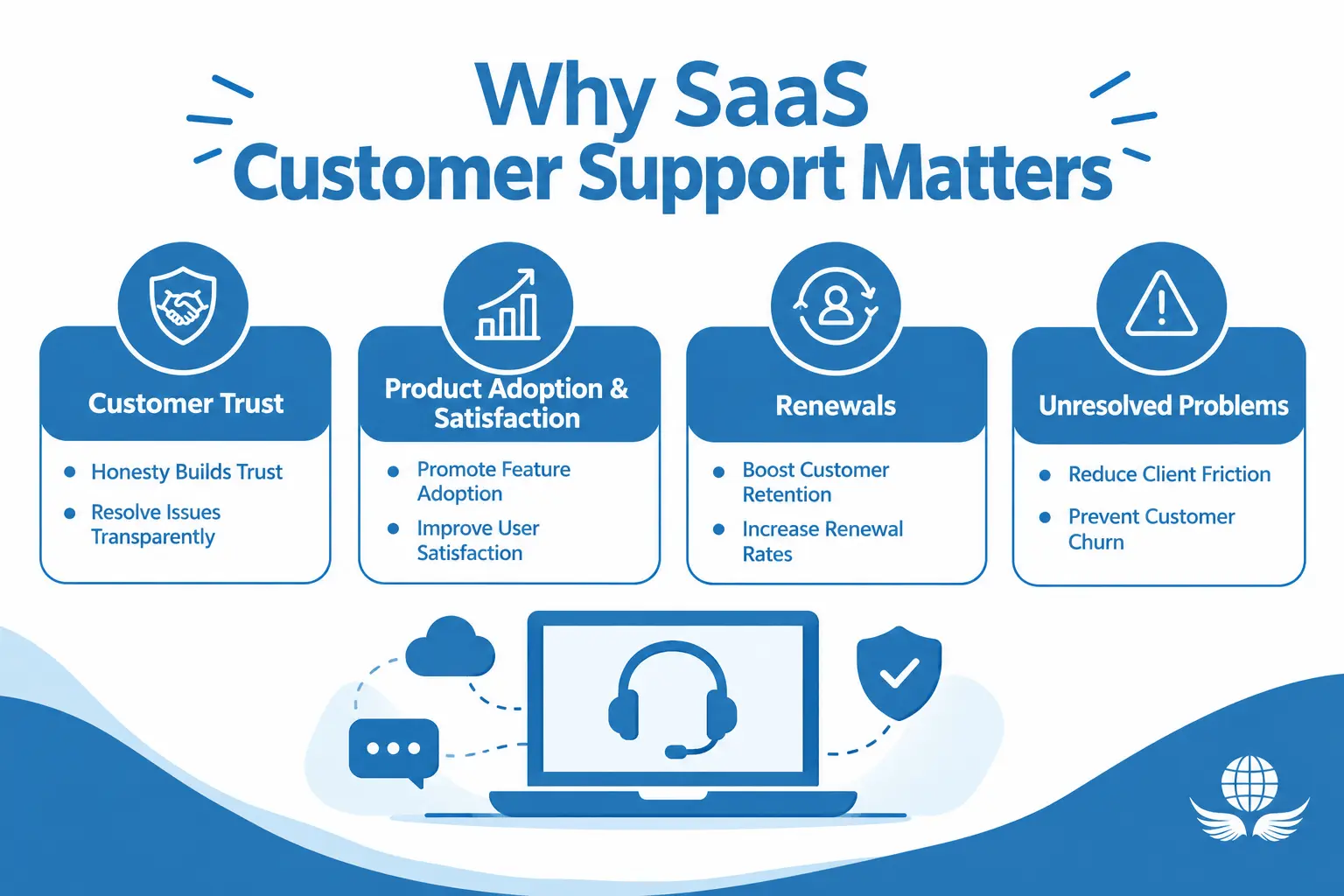
Customer Trust
Clients judge their vendor by how they handle problems. An honest answer, even if the problem will take a while to resolve, builds confidence.
Product Adoption and Satisfaction
Many features go unused because users are unaware they exist. Conversations and support are natural times to show the next step.
Renewals
In B2B software, renewal decisions may be made months before the contract date, based on friction that built up throughout the year. According to Bain & Company studies, a 5% gain in customer retention raises profit by more than 25% in financial services.
The Cost of Unresolved Problems
An open issue doesn’t remain small. It slows down a client’s team and gives a competitor an opportunity. Support won’t fix a bad product, but it will definitely shape the customer experience.
Common Customer Support Challenges for SaaS Companies
Growing Ticket Volume
Volume rises with every new customer, release, and pricing change. With our Erlang staffing calculator, you can estimate how many agents you need to achieve a desired service level before launch.
Complex Technical Questions
Integrations and data imports require SaaS technical skills, which a general agent may not have. These tickets are bounced between teams without any clear escalation.
Scaling the Team
Recruitment, training, and scheduling take months. Many emerging businesses need to scale customer support solution that can scale without extending the hiring process.
Rising Customer Expectations
Business users want assistance during business hours, which can span time zones across Canada, the United States, and Europe.
Consistent Service Quality
When knowledge lives in a few people’s heads, quality suffers. Answers are consistent with shared documentation and call reviews.
How SaaS Customer Support Improves Customer Retention
Support is a retention factor because it can help customers reach value faster and eliminate unnecessary drivers of customer attrition. It can’t save an account that no longer needs the product. Four habits are crucial for B2B SaaS customer support teams.
Faster Time to Value
Guided onboarding, setup checklists, and early check-in calls help new accounts achieve proper product use within weeks.
Resolving Issues the First Time
A Harvard Business Review study of over 75,000 customers found that ease of problem resolution predicted loyalty better than satisfaction scores. A thorough reply earns one complete answer; a fast answer is worth three more tickets.
Closing the Loop With Product Teams
Support contacts customers with recurring bugs, tags them to the product teams, and helps fix the problem.
Proactive Outreach
Contacting clients before renewal, after an outage, or when usage drops shows you’re paying attention. This outreach should follow a rhythm driven by structured welcome and retention calls.
How to Spot Customers at Risk of Leaving
| Warning Sign | What It May Mean | Follow Up Action |
|---|---|---|
| Repeat tickets on the same issue | The fix did not hold | Escalate and assign one owner |
| Drop in logins or feature use | Value is fading | Offer a short training session |
| Low satisfaction scores or angry comments | Frustration is building | Senior agent calls within one business day |
| Main contact leaves the client company | Internal champion is lost | Introduce your team to the new contact |
| Silence before renewal after past issues | Quiet disengagement | Book a review call with customer success |
| Questions about data export or cancellation terms | Alternatives are being tested | Alert the account owner the same day |
Don’t mistake these indicators for evidence of churn; use them as a starting point for a conversation. Our guide to customer retention strategies covers longer-term approaches.
The Role of SaaS Customer Success
Customer support will address issues as they arise. Customer success is about the whole picture and aiding the client to reach their business goals, like adding a new module. The support is mostly reactive and ticket-based. Adoption, account health, and renewals are the three key metrics for proactive success.
How the Two Teams Work Together
- Success Managers will receive caution flags for at-risk accounts and recurring product gaps.
- Success will communicate objectives to agents and provide background information.
- The two teams share the same customer record.
- The teams review open tickets and satisfaction trends during the joint review before renewal.
You can find more ways to connect the two teams in our article on SaaS customer support strategies.
SaaS vs Traditional Customer Support
Traditional support is for one-time purchases. SaaS support is for clients who choose to renew.
| Factor | SaaS Customer Support | Traditional Customer Support |
|---|---|---|
| Relationship | Ongoing for the full subscription | Mostly at purchase and warranty |
| Main goal | Adoption, renewal and expansion | Fix the issue and close the case |
| Product changes | Frequent releases need regular retraining | Product stays largely the same |
| Channels | Chat, email, phone and help articles | Mainly phone and email |
| Agent context | Usage, plan and account history | Order or warranty details |
| Success measure | Retention and customer health | Case closure and cost per contact |
The main distinction is time. If the client is still active and paying next year, then a SaaS team is successful.
Technical Support Outsourcing for SaaS Companies
External help makes sense when ticket volume grows faster than hiring, clients need coverage outside office hours, or new markets need other languages. Some vendors call it customer service as a service; you can pay for trained agents, supervision, and tools as a service rather than building a complete function in-house.
How Escalation Works With an Outsourced Team
- The partner is responsible for Tier 1 and usually Tier 2, and the knowledge base/scripts.
- An approved ticket path to your engineers for issues that need code changes.
- Agents advise customers when they think an update is coming.
- Review escalations weekly to close knowledge gaps for both teams.
Why Product Knowledge, Training and Security Matter
For SaaS technical support, agents need to be familiar with your product, rather than general troubleshooting. Look for organized training, readiness, and post-release refresher sessions. Security is also key.
PIPEDA regulates how the private sector uses personal information, so it’s important to ask about the partner’s approach to managing access to their systems and information in Canada.
Agents Republic provides technical support, from solving common issues to advanced assistance. Our earlier piece on software support outsourcing covers the benefits of SaaS customer support outsourcing in more depth.
Technology That Supports SaaS Customer Support
| Tool | How It Helps Retention |
|---|---|
| Help desk software | Tracks every ticket, owner, and deadline |
| Ticket routing | Sends each request to the right tier or language |
| Knowledge base | Gives clients and agents the same trusted answers |
| Chat and messaging | Offers quick help inside the product |
| Customer data tools | Shows plan, usage and history in one view |
| Reporting | Reveals trends, workload and quality gaps |
Tools support people and processes; they do not replace them. Our guide to customer support operations explains how people, processes,s and technology fit together.
Best Practices for SaaS Customer Support
Use the following practices to deliver proactive support that keeps customers satisfied vand loyal.
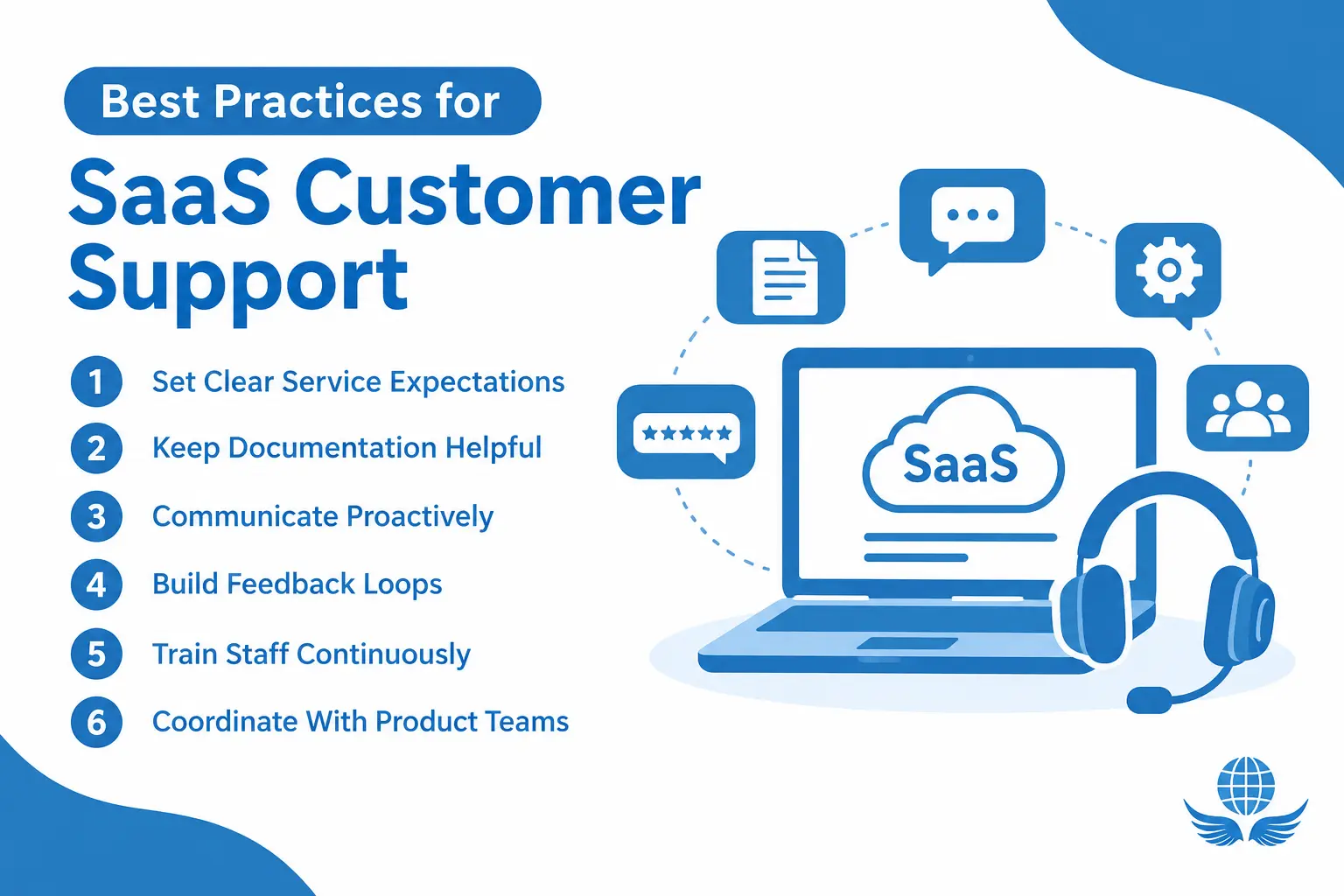
Set Clear Service Expectations
Set expected response times by priority and channel and ensure they are realistic.
Keep Documentation Helpful
Update articles with every release and write them in the customer’s terminology.
Communicate Proactively
Advise clients of incidents and other planned changes early.
Build Feedback Loops
Label tickets with the cause and report the most common issues to leadership each month.
Train Staff Continuously
Discuss product updates, communication, and data security frequently.
Coordinate With Product Teams
Discuss a method for prioritizing bugs and communicating bug fixes to clients.
Common Mistakes to Avoid
- Slow follow-up: Clients feel forgotten after the first reply.
- Generic responses: Copied answers ignore the client’s actual setup.
- Weak escalation: Tickets don’t move because no one knows who is responsible.
- Ignoring recurring problems: The same problem gets solved 50 times instead of fixed once.
- Tickets only: More closed tickets don’t necessarily mean happier clients.
What to Look for in a SaaS Customer Support Partner
- Experience with software and IT call center services
- Structured onboarding and product training
- Quality checks such as call reviews and scorecards
- Real-time reporting you can access
- Coverage hours and languages that match your clients
- Transparent data management and compliance
- A written escalation process
Our RFI questions help structure the evaluation.
Shared or Dedicated Support?
Agents Republic has 2 models. A minute-based, English-only answering service for simple, repeatable requests. The monthly plans are listed on the 24/7 answering service page.
Dedicated support is the best option for most SaaS companies. Agents work only on your behalf and can use your CRM, ticketing system, and knowledge base at no extra cost.
Pricing is based on agreed coverage hours: the agent hourly rate multiplied by the hours you need, plus a fixed monthly supervision fee. Dedicated teams cover over 100 languages, with bilingual customer service in English and French.
Our guide to call center pricing explains how we build quotes.
Measuring the Success of SaaS Customer Support
No industry standards exist for SaaS customer support metrics. You will see different patterns when using a tool at month-end compared to using it daily. Create your own targets based on your personal baseline, customer type,e and support model.
| Metric | What It Measures | Simple Calculation |
|---|---|---|
| First response time | Time until the first human reply | Reply time minus ticket creation time |
| Resolution time | Time until the issue is fully solved | Close time minus creation time |
| Customer satisfaction (CSAT) | How satisfied the client felt after a contact | Positive answers ÷ all answers × 100 |
| Customer effort score (CES) | How easy it was to get help | Share of clients who agree it was easy |
| Reopened tickets | Fixes that did not hold | Reopened ÷ resolved tickets × 100 |
| Churn rate | Customers lost in a period | Customers lost ÷ customers at start × 100 |
| Revenue retention | Recurring revenue kept from existing clients | Revenue now ÷ revenue 12 months ago × 100 |
| Customer health score | Overall risk for each account | Weighted mix of usage, tickets and billing signals |
For reference, the SaaS Capital survey mentioned above notes that in 2025, private B2B companies had a median net revenue retention of 101% and gross revenue retention of 91%. Use these only as benchmarks, as outcomes vary with contract size. If the same accounts are opening tickets, a quick first reply will not matter
The Future of SaaS Customer Support
Self-service and personalization will improve, while AI will handle more routine requests and help support agents draft responses. Customers want people for complex cases, but they also want automation.
A Gartner survey found 64% of customers would prefer companies did not use AI for customer service. Gartner also forecasts that by 2027, half of organizations planning significant service cuts will cancel them. Our guide to AI customer support shows how both can work together.
Conclusion
Customer support plays a key role in retention by speeding up onboarding, ensuring customers get fixes quickly, and alerting them to risks. It works best when paired with customer success and clear metrics.
If your team is overextended, a trained partner can provide additional coverage. Agents Republic is a Vancouver-based BPO company with offices in Europe and Asia, spanning all time zones.
Call +1 (604) 210-8100 or request a quote to build support that keeps your clients renewing.
Frequently Asked Questions
What exactly is SaaS customer support?
SaaS customer support is ongoing support a software company provides to customers throughout the contract term, not just at purchase. It includes onboarding, account and billing inquiries, troubleshooting, and feature guidance via email, chat, and phone. Clients renew regularly, so support quality directly affects who pays for the product.
How does SaaS customer support reduce customer churn?
It removes friction that pushes clients to cancel, such as slow responses and recurring issues. Onboarding help reduces time to value, and proactive outreach identifies issues before renewal. While support isn’t the answer to a poor fit, it can prevent unnecessary losses from unsold tickets, feature confusion, and clients who feel helpless.
Which metrics should SaaS companies use to measure customer support?
Monitor first response time, resolution time, customer satisfaction, customer effort, customer churn, and revenue retention. Introduce a customer health metric for each account based on usage, ticket, and billing signals. Don’t use generic targets; set targets based on your own baseline, as results will vary by product, contract size & support model.
How can SaaS businesses identify customers at risk of leaving?
Look for repeat tickets on the same issue, declining login activity, low satisfaction scores, the main contact leaving before renewal, and a lack of communication before renewal. Questions about data export or cancellation terms are particularly strong indicators. If you see any warning signs, assign one owner and contact the client promptly with a clear action plan to resolve the issue.
When should a SaaS company outsource customer support?
Outsourcing works well when ticket volume is growing faster than you can hire, clients need out-of-hours coverage, or you need additional languages during launches and peak periods. Hire a partner to train reps on your product and operate within your systems. The partner should also follow your escalation rules and respect customer privacy and data, as required by Canadian privacy laws.